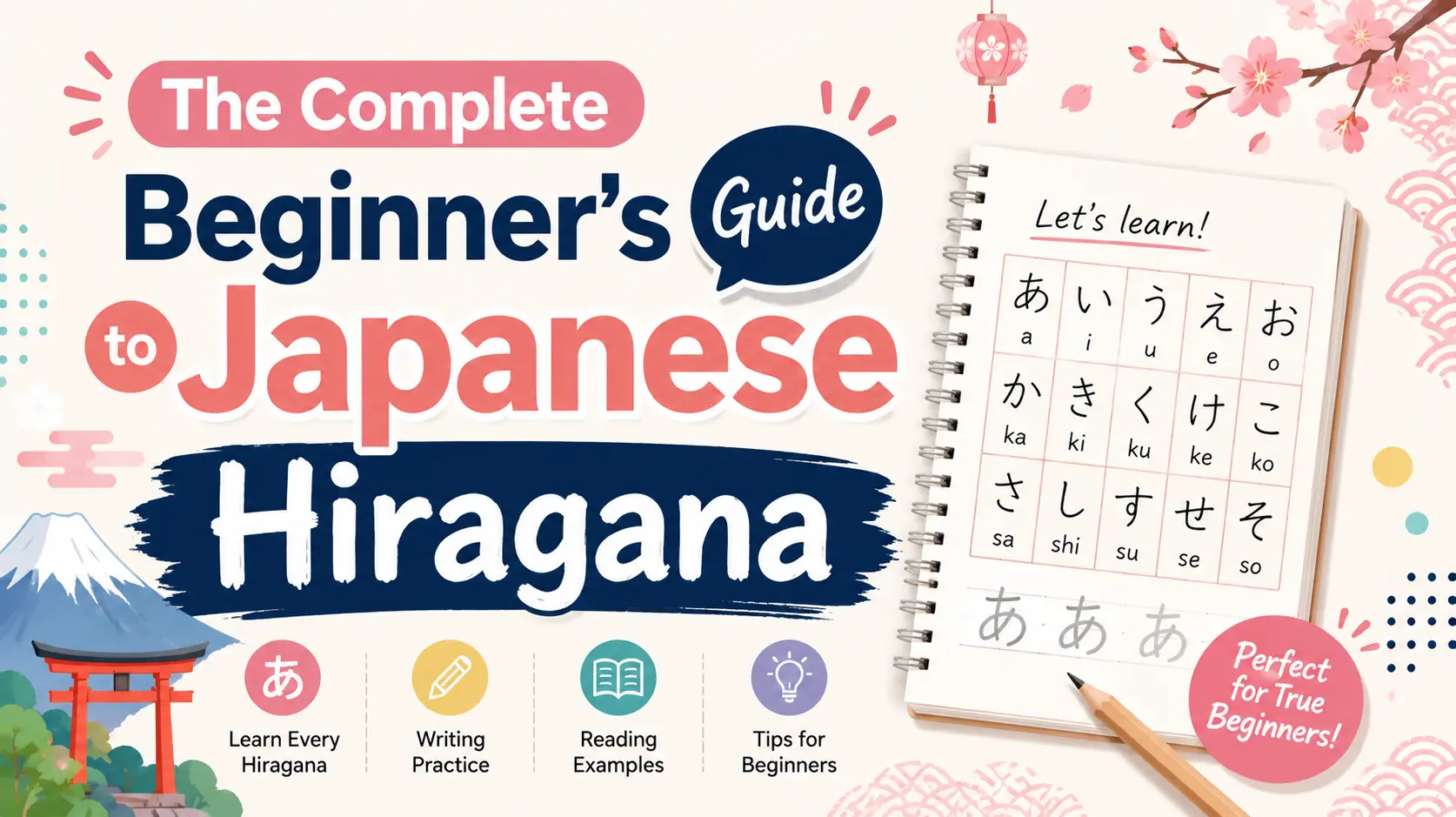
The Complete Beginner's Guide to Japanese Hiragana
What Is Hiragana?
Hiragana (ひらがな) is one of the three writing systems used in Japanese.
The Japanese writing system consists of:
- Hiragana (ひらがな) – Used for grammar, particles, native Japanese words, and words without kanji.
- Katakana (カタカナ) – Used for foreign words, loanwords, company names, and emphasis.
- Kanji (漢字) – Characters originally borrowed from Chinese that represent meanings.
Unlike English, Japanese does not use an alphabet. Instead, hiragana is a syllabary, meaning each character represents a sound rather than an individual letter.
For example:
| Hiragana | Pronunciation |
|---|---|
| あ | a |
| か | ka |
| さ | sa |
| た | ta |
| な | na |
There are 46 basic hiragana characters, and learning them allows you to read many beginner-level Japanese words and sentences.
Why Learn Hiragana?
Every beginner should start with hiragana because it forms the foundation of written Japanese.
Here are some reasons why learning hiragana is essential:
- Almost every Japanese sentence contains hiragana.
- Japanese grammar is written mainly in hiragana.
- Japanese children learn hiragana before katakana and kanji.
- Most beginner textbooks introduce hiragana first.
- The JLPT N5 exam expects learners to read hiragana comfortably.
- Knowing hiragana makes learning vocabulary and grammar much easier.
Once you've mastered hiragana, reading simple Japanese becomes much more enjoyable.
The Complete Hiragana Chart
Below are the 46 basic hiragana characters.
| Vowel | K | S | T | N | H | M | Y | R | W |
|---|---|---|---|---|---|---|---|---|---|
| あ (a) | か (ka) | さ (sa) | た (ta) | な (na) | は (ha) | ま (ma) | や (ya) | ら (ra) | わ (wa) |
| い (i) | き (ki) | し (shi) | ち (chi) | に (ni) | ひ (hi) | み (mi) | り (ri) | ||
| う (u) | く (ku) | す (su) | つ (tsu) | ぬ (nu) | ふ (fu) | む (mu) | ゆ (yu) | る (ru) |
Additional character:
- ん (n)
A good way to memorize the chart is to begin with the vowel row (あ・い・う・え・お) before moving on to each consonant row one by one.
Hiragana Pronunciation Guide
Most hiragana have consistent pronunciation, making them easier to learn than English spelling. However, a few sounds are unfamiliar to many beginners.
し (shi)
Although written as shi, the pronunciation is closer to "shee" than "see."
Example:
- しお (shio) — Salt
- しろ (shiro) — White
ち (chi)
The character ち is pronounced like "chee."
Example:
- ちず (chizu) — Map
- ちかてつ (chikatetsu) — Subway
つ (tsu)
The ts sound can be difficult for beginners because it does not exist in many languages.
Example:
- つき (tsuki) — Moon
- つくえ (tsukue) — Desk
ふ (fu)
Japanese ふ is softer than the English "foo." Your lips should not fully close when making the sound.
Example:
- ふね (fune) — Ship
- ふゆ (fuyu) — Winter
ら・り・る・れ・ろ
The Japanese R sound is unique. It is produced with a light tap of the tongue and sounds somewhere between the English R, L, and a soft D.
Example:
- らいねん (rainen) — Next year
- りんご (ringo) — Apple
- るす (rusu) — Away from home
- れいぞうこ (reizouko) — Refrigerator
- ろく (roku) — Six
Dakuten and Handakuten
Some hiragana change their pronunciation by adding small marks.
Dakuten (゛)
Dakuten changes the sound into a voiced consonant.
| Base | Changed |
|---|---|
| か → | が |
| き → | ぎ |
| く → | ぐ |
| け → | げ |
| こ → | ご |
| さ → | ざ |
| し → | じ |
| す → | ず |
| せ → | ぜ |
| そ → | ぞ |
| た → | だ |
| ち → | ぢ |
| つ → | づ |
| て → | で |
| と → | ど |
| は → | ば |
| ひ → | び |
| ふ → |
Examples
- がくせい (student)
- でんしゃ (train)
- ばんごはん (dinner)
Handakuten (゜)
Handakuten is only used with the H-row and changes the sound to P.
| Base | Changed |
|---|---|
| は → | ぱ |
| ひ → | ぴ |
| ふ → | ぷ |
| へ → | ぺ |
| ほ → | ぽ |
Examples
- ぺん (pen)
- ぽけっと (pocket)
- ぷーる (pool)
Combination Sounds (Yōon)
Some hiragana combine with the small versions of や (ゃ), ゆ (ゅ), and よ (ょ) to create new sounds.
These are called yōon.
| Combination | Pronunciation |
|---|---|
| きゃ | kya |
| きゅ | kyu |
| きょ | kyo |
| しゃ | sha |
| しゅ | shu |
| しょ | sho |
| ちゃ | cha |
| ちゅ | chu |
| ちょ | cho |
| にゃ | nya |
| ひゃ | hya |
| みゃ | mya |
| りゃ | rya |
Examples
- きょう (today)
- しゃしん (photo)
- りょこう (travel)
- にゅうがく (school entrance)
Small っ (Sokuon)
The small っ is called sokuon. It indicates that the following consonant is doubled, creating a short pause before the next sound.
Compare these examples:
| Word | Meaning |
|---|---|
| きて | Come (command) |
| きって | Stamp |
| がこう | (Incorrect spelling) |
| がっこう | School |
| さか | Hill |
| さっか | Author |
Although the character itself is small, it plays an important role in pronunciation and meaning.
Long Vowels
Japanese distinguishes between short and long vowel sounds. Holding a vowel for a little longer can change how a word is pronounced.
Long vowels are commonly written using combinations such as:
- ああ
- いい
- うう
- えい
- おう
- おお
Examples include:
| Word | Meaning |
|---|---|
| おばあさん | Grandmother |
| おにいさん | Older brother |
| せんせい | Teacher |
| とうきょう | Tokyo |
| こうえん | Park |
Listening carefully to native pronunciation will help you recognize and produce long vowels naturally.
Common Hiragana Words
Once you've learned the basic characters, try reading these common Japanese words.
| Japanese | Romaji | Meaning |
|---|---|---|
| おはよう | ohayō | Good morning |
| こんにちは | konnichiwa | Hello |
| こんばんは | konbanwa | Good evening |
| ありがとう | arigatō | Thank you |
| さようなら | sayōnara | Goodbye |
| はい | hai | Yes |
| いいえ | iie | No |
| ねこ | neko | Cat |
| いぬ | inu | Dog |
| みず | mizu | Water |
| ごはん | gohan | Rice / Meal |
| さくら | sakura |
These everyday words are excellent practice because they use only basic hiragana and appear frequently in beginner Japanese.